Established in 2006, KingstonCitizens.org is a non-partisan, grassroots, volunteer organization committed to nurturing transparency in local government through citizen engagement and participation.
Please subscribe to keep updated on the latest events concerning our community. (*required)
The proposed battery storage project in New Paltz raises questions that Kingston should be paying attention to now.
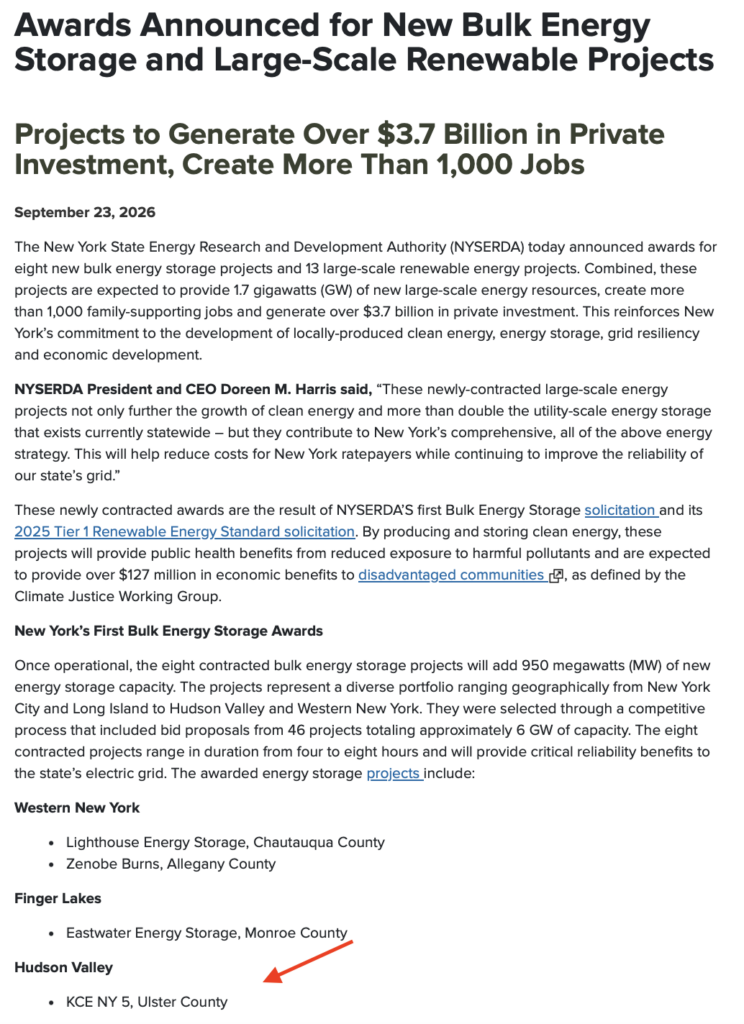
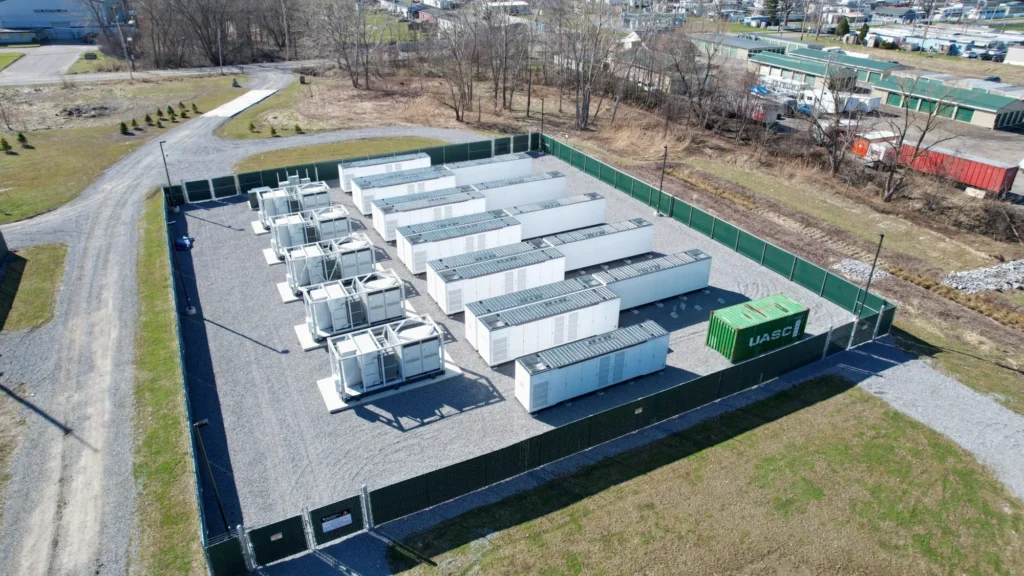
KCE NY 5 battery energy storage system, a proposed 100 MW battery storage project, was recently selected by NYSERDA for a state energy-storage award. The project is proposed for County-owned property in New Paltz, and the company’s project summary says it planned to seek a Special Use Permit and Site Plan Approval from the Town of New Paltz.
At the same time, Ulster County is seeking to become the SEQR lead agency for the project.
We don’t know whether County-owned land would be involved in a future battery storage proposal in Kingston, or if the New Paltz project would set a precedent. What happens to local zoning authority when a project involves County property and the County seeks to take the lead role in environmental review?
That is one reason a moratorium deserves serious consideration in Kingston. It would give the City time to establish clear local standards and determine how these small-scale battery storage projects should fit within Kingston’s zoning and comprehensive planning framework—before a specific project forces those questions.
This is moving quickly, with BESS and land use all new. Kingston should not wait for a developer, the County, or the State to determine what is best for the City.
According to the U.S. Food and Drug Administration (FDA), 1 “Kratom is a tropical tree that is native to Southeast Asia. Products prepared from kratom leaves are available in the U.S. online and in brick-and-mortar stores. Kratom is often used to self-treat conditions such as pain, coughing, diarrhea, anxiety and depression, opioid use disorder, and opioid withdrawal.” The Centers for Disease Control and Disease Prevention (CDC) recently reported that 5 million Americans have used kratom and that, in the past five years, there has been, “an increase of approximately 1,200% in kratom-related exposure reports, including a marked surge in 2025.” 2
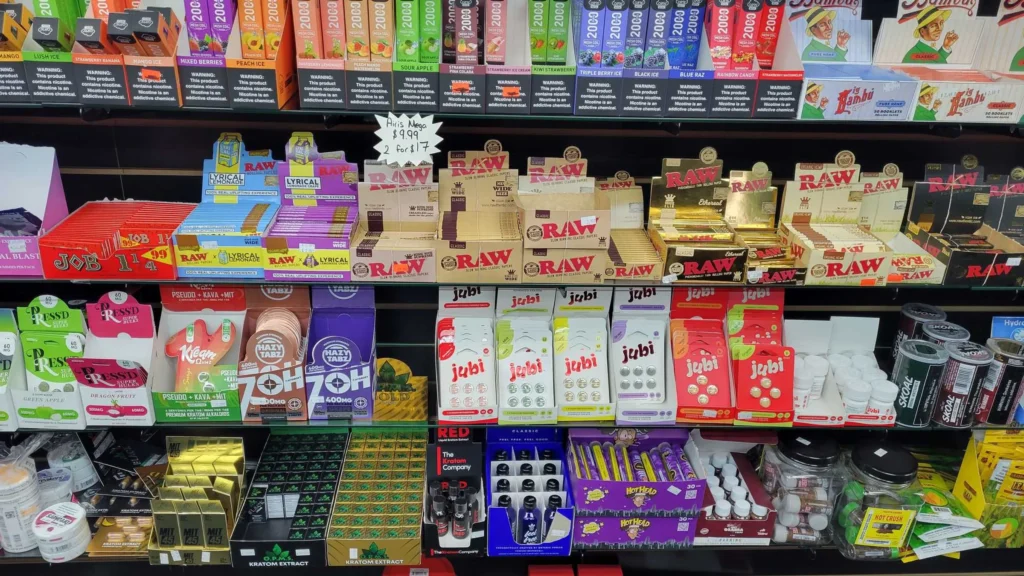
It is scientifically and medically accurate to say that kratom has opioid activity because its active compounds bind to the same brain receptors targeted by traditional opioid drugs. Despite that, kratom products are being sold openly in gas stations, convenience stores, smoke shops, and online marketplaces. Kratom is sold as tablets, gummies, drink mixes, drinks, and powders.
The FDA describes kratom products as potent opioid products that have not been proven safe or effective for any use. But to date, the concern from federal regulators has been particularly focused on kratom that is concentrated and has synthetic 7-hydroxymitragynine, or 7-OH, additives. Federal actions have been aimed at elevated concentrations of 7-OH and synthetic derivatives, not ordinary botanical kratom containing naturally occurring 7-OH that is below the federal threshold.
That distinction does not mean that natural kratom is harmless or without risks; it means that these are different products that may need to be considered separately. Even without added 7-OH, natural kratom can lead people with addictive tendencies to kratom addiction, illegal opioid use, or jumpstart a recovering addict’s opioid relapse because kratom contains active chemical compounds that interact with the exact same brain pathways as prescription opioids and heroin. 3 Pharmacologically, natural kratom functions as a partial opioid agonist, despite being marketed as a “natural” or “safe” herbal supplement. 4
This raises the question of whether the current regulatory framework is keeping pace with these products. Products with opioid-active compounds can be widely available in ordinary retail settings while failing under a different regulatory framework than conventional opioid drugs. For consumers and local governments, that can look like a regulatory gap: the federal government is now moving to address the most concentrated and synthetic forms, while other kratom products remain readily available. The question is whether the current framework is adequate for products whose potency and effects can vary, and whether manufacturers should have to demonstrate safety before these products reach consumers.
The stakes are high. The growing availability of products with potent opioid effects in ordinary retail settings—including gas stations, smoke shops, and convenience stores—is particularly concerning, putting these products within easy reach of young people and people struggling with addiction.
The Federal Government Is Moving
On July 1, 2026, the Drug Enforcement Administration (DEA) announced that it was beginning the process of temporarily placing 7-OH above a specified threshold and three synthetic 7-OH-related substances into Schedule I under the federal Controlled Substances Act. In August, the DEA issued a temporary scheduling order for the three synthetic derivatives. The separate process for 7-OH above the proposed threshold has involved additional federal review and public comment over what concentration should trigger scheduling. 5
The federal landscape is therefore moving, but it is not completely settled.
That uncertainty is one reason why some local governments are having difficulty deciding exactly what they can and should regulate, how a local law would interact with federal scheduling, and who would enforce it.
New York State Has Already Acted
New York has already taken some steps to address kratom. In December 2025, Governor Kathy Hochul signed legislation prohibiting the sale of Kratom products to anyone under 21 and requiring every kratom product manufactured, distributed or sold in New York to carry a consumer warning label and a full list of ingredients. The warning must state that the product may be addictive and may interact with certain medications, drugs, and controlled substances. 6
The State Legislature has now gone further. Assembly Bill A.9156B, 7 sponsored by Assemblymember Phil Steck, and its Senate counterpart, S.8925A, 8 sponsored by Senator Christopher Ryan, would prohibit the sale of products containing 7-OH above specified thresholds: more than 2 percent of total alkaloids or more than one milligram per serving. The legislation also establishes civil penalties for businesses that knowingly sell, offer for sale or deliver prohibited 7-OH products.
That gives New York counties something concrete to prepare for and act on right now: the Governor is expected to sign these bills that have already passed both houses before the end of the year.
This past June, both Sarahana Shrestha and Michelle Hinchey, Ulster County’s state legislators, voted in support of the legislation that is awaiting Governor Hochul’s signature.
The Precautionary Principle and the Federal Role
The precautionary principle is a decision-making framework that involves risk assessment to determine whether or not “an activity raises threats of harm to human health or the environment, (and that) precautionary measures should be taken even if some cause-and-effect relationships are not fully established scientifically.”9
Kratom regulation is an example of why adopting the precautionary principle is critical. When products can pose serious health risks, the burden should not fall on the public to prove they are dangerous after they are already on the market and readily available. Companies that manufacture and market kratom products should have had to demonstrate their safety before those products reach consumers—not after harm has occurred.
There are no FDA-approved over-the-counter drugs or dietary supplements containing kratom that are legally marketed in the U.S. In fact, the FDA warns consumers not to use kratom because of “the risk of serious adverse events, including liver toxicity, seizures, and substance use disorder (SUD).” 10 Yet kratom products are still widely sold by companies that market them outside the FDA-approved drug or dietary supplement framework. In other words, the absence of FDA approval does not prevent these products from reaching consumers.
That is an important question for our local members of Congress, Pat Ryan and Josh Riley, to raise at the federal level. The precautionary principle should also be part of any local memorializing resolution adopted by a county or municipality addressing kratom: companies should bear the burden of demonstrating safety before these products reach consumers, rather than leaving consumers, families, communities and taxpayers to bear the consequences after the fact.
What Other Counties Are Doing
In the Mid-Hudson region, there has been a mix of responses to kratom regulation.
Dutchess County has acted, but not without a difference of opinion over how far to go. On August 10, 2026, the Dutchess County Legislature adopted a local law prohibiting the sale and distribution of concentrated and synthetic 7-OH products while allowing adults to continue to purchase natural leaf kratom.
County Executive Sue Serino initially proposed a much broader approach – a ban on the sale of all kratom products. 11 The County Legislature ultimately adopted a narrower law, Local Law No. 6 of 2026: Prohibiting the Sale and Distribution of Concentrated and Synthetic 7-Hydroxymitragynine (7-OH) Kratom Products in Dutchess County. 12
The difference between the County Executive’s original proposal and the Legislature’s final law shows that a county does not necessarily have to resolve every question about kratom before taking action on the products at the center of the current federal concern. The scope of a proposed law can be debated, narrowed, and worked through the legislative process.
Dutchess County held its required public hearing, heard from constituents and advocates, consulted with its Department of Health and ultimately adopted the narrower legislation. Serino acknowledged that the legislation did not go as far as the complete ban she had proposed, while indicating that she would continue to explore additional action.
Sullivan County is developing its own policy. County documents show that Sullivan County has drafted a county mandate proposal addressing kratom policy as part of its broader work on substance-use treatment and prevention. It has not enacted a county kratom ban. 13
Orange County provides another example of the different routes to regulation local counties are taking with kratom. In 2025, Orange County moved to prohibit the sale of kratom to people under 21 before New York enacted its statewide age restriction. But shortly after the county acted, the state law took effect. County officials subsequently explained that the local law did not proceed through the remaining process because the state legislation had superseded the need for it. By spring 2026, the County Department of Health was waiting for state guidance on its role in enforcing the new state requirements and was developing public information about kratom and the distinction between natural and synthetic products. 14
Outside of our region, there are several examples of New York State counties banning all forms of kratom. Albany, Nassau, Oneida, Rensselaer, and Washington counties have all bypassed the state-level regulations to enact complete, local retail bans on all forms of kratom. Saratoga County will have its final public hearing in October and is currently moving through the legislative process to finalize its own total ban. 15 16 17 18 19 20
Despite these examples, in our region, counties are struggling to move this issue forward. We understand that state and federal law are changing quickly and that local laws can be overtaken by state legislation. Questions about preemption, enforcement authority and the appropriate regulatory threshold remain. And county health departments may not have authority or capacity to enforce a law regulating a substance that falls outside their existing jurisdiction. But counties that have enacted full bans are working through those same challenges, and their experiences can help inform a path forward for Ulster County. Given the life-and-death nature and speed with which this kratom crisis is escalating, challenges are a reason to work through the details, not a reason to stop looking for solutions. If other counties are finding ways to move forward, Ulster County should learn from what they are doing.
There are also certainly short, mid, and long-term actions that can be taken to move toward the goal of restricting access to kratom, even as the state and federal landscape continues to evolve. Those next steps need to be identified, understood, and made clear to the public. The community has the most at stake here, and people need to know what is being considered, what can be done now, what will take more time, and where their voices and actions can make a difference.
A Regional Problem Needs Regional Solutions
This is bigger than a question of where these products can be sold. If people are becoming dependent on them, then access to treatment has to be part of the conversation too.
Ulster County is part of a regional system. The response should consider not only what happens at the point of sale, but also what happens when someone develops a substance-use problem and needs help.
People who develop dependence on kratom or concentrated 7-OH products may need substance-use treatment, including detoxification and recovery services. Treatment providers in the region are increasingly encountering kratom-related dependence, while access to detox beds remains a challenge. Ulster County has not had any certified inpatient hospital detox beds since 2021 when the last remaining beds in Ulster were moved to Dutchess County. 21 Community members who need detox or recovery services may have to leave their own county to get them, including seeking treatment in Dutchess County.
At the same time, critics of county-by-county restrictions have raised concerns about spillover effects – that is, that people could simply cross county lines to obtain products that are restricted in their home county. Whether that is happening in practice is a question worth examining, but the underlying policy gap is that a product that cannot be sold in one county may remain readily available a short drive away.
That means the availability of these products, access to treatment, and policies in neighboring counties are all part of the same regional picture. The costs should not fall entirely on families, communities, treatment systems, and taxpayers. The companies making, marketing, and profiting from these products should bear responsibility for the costs associated with the harm they create.
We urge our Mid-Hudson county leaders to bring the issue to the New York State Association of Counties (NYSAC) 22 to propose and create a coordinated regional and statewide approach. If the goal is to restrict access to kratom, counties can begin talking now about how to address gaps between neighboring counties, enforcement challenges, treatment capacity, and what can be done if state or federal action stalls or does not address the issue fully.
Where Ulster County Stands
Ulster County was poised to bring Proposed Local Law No. 16 of 2026 23 to a public hearing. The proposed law would prohibit the sale and distribution of concentrated and synthetic 7-OH kratom products in the County. Instead, on September 3, the Health, Human Services and Human Rights Committee voted 5–2 to postpone Resolution No. 480, which would have set the public hearing. The legislation remains before the County, but the public hearing, and the opportunity for community members to weigh in, has been put on hold.
Legislator Bill Murray, the sponsor of Proposed Local Law No. 16, 24 has been clear about the need for action. In a recent press release, 25 he called for Ulster County to “immediately ban the sale and distribution of high concentrations and synthetic kratom” while state and federal action moves forward, citing concerns about its addictive nature, misleading marketing and misinformation. By putting the legislation forward and publicly calling for action, Murray has helped bring this issue to the County’s attention. The next step is to bring that legislation to the public and do the work needed to make it effective.
The County Executive’s Office raised concerns about the rapidly changing state and federal legal landscape. The County Department of Health also explained that it does not currently have enforcement authority over drugs and would not have the capacity to police possession or online sales.
But postponing the public hearing does not resolve those questions. It delays the opportunity to hear from the public and work through them in an open process. Legislator Craig Lopez and others were correct that a public hearing is tied to a specific proposed local law. But that does not mean the County has to wait until every detail is settled before engaging the public. The proposed law can be developed, revised and improved through the legislative process, with additional public hearings as it evolves.
For an issue this new to Ulster County, several rounds of discussion and public input are reasonable. The cost is time and work, but that work has value. A public process can educate the community, build understanding and buy-in, surface practical solutions, and identify what the County needs to make the law work. It may even lead the public and their legislative stewards to determine that additional resources or funding are needed for enforcement, education or other aspects of implementation. That is exactly what a public process is supposed to do: bring the community and its elected representatives together to work through new and complicated issues and develop the strongest response possible.
We support a full kratom ban, as has already been enacted in Albany, Nassau, Oneida, Rensselaer, and Washington counties. Those counties have paved the way and provide a road map for Ulster to learn from and follow.
Additionally, Ulster County, at this moment in time, does not have to choose between working on its local law and taking action now. There are both short-term and longer-term actions the County can take while the state and federal landscape continues to evolve.
In the short-term, the County Legislature can adopt a memorializing resolution urging Governor Hochul to sign S.8925A/A.9156B, the 7-OH legislation that has passed both houses of the State Legislature. The resolution could also call on our house representatives to raise two important issues at the federal level: the precautionary principle and producer responsibility. Companies making, marketing and profiting from products with potent opioid effects should bear responsibility for the harms and costs associated with those products, rather than leaving them to consumers, families, communities, treatment systems and taxpayers.
Longer-term, Ulster County can continue developing its own local response. Proposed Local Law No. 16 raises important questions about who has enforcement authority, how online sales would be addressed, and how a county law would interact with state and federal requirements. Any questions can and should be worked through publicly as the legislation evolves. The half a dozen counties that have enacted full bans should be used as models for working towards taking the same actions in Ulster County.
Take Action
Ask that the Ulster County Legislature immediately pass a memorializing resolution urging Governor Hochul to sign S.8925A/A.9156B and to include language about the precautionary principle, producer responsibility, and the need for adequate treatment capacity in the County’s response.
Urge the Ulster County Legislature to bring Local Law No. 16 of 2026 back for a public hearing and continue improving it through the public process, which may include additional public hearings.
Support your Ulster County legislators to move forward with a collaborative public awareness campaign involving the County Legislature, County Executive, Department of Health and Sheriff’s Office addressing kratom, and all other addictive substances as a public health and public safety issue.
Urge Mid-Hudson county leaders to bring kratom to New York State Association of Counties (NYSAC) and work toward a coordinated regional and statewide approach, including addressing gaps between neighboring counties, enforcement challenges, treatment capacity and what to do if state or federal action falls short.
Show up, speak out and stay engaged as the County works through its next steps.
In full disclosure, in March 2022, after several months off of opioids, co-author Tobin’s son Padraig Flusser died of “acute intoxication due to the combined effects of Fentanyl, Flourofentanyl, Alprazolam, Clonzipan, and Mitragynine.” Mitragynine is the primary active chemical compound (alkaloid) found in kratom. 7-OH kratom did not come on the market until 2023. Natural kratom leaf is rarely a singular cause of death, but rather a compounding factor that worsens respiratory failure when combined with other drugs. Kratom usage interacts with the same brain pathways as other opioids and heroin and can lead to relapse. The level of Mitragynine (260ng/ml) in Padraig’s autopsy toxicology report indicates heavy or frequent kratom use.
By Lorraine Farina, Hudson Valley Air Quality Coalition (HVAQ) and Rebecca Martin, KingstonCitizens.org
This is part of KingstonCitizens.org’s ongoing series examining the City of Kingston’s Burn Ban legislative process
On September 1, the Common Council voted 7–0 to enact a temporary burn ban during periods of high fire danger designated by the New York State Department of Environmental Conservation (NYSDEC). Hudson Valley Air Quality Coalition (HVAQ) has advocated for such a ban since March, 2025. When fire danger is high, eliminating all potential sources of ignition can reduce fire risk.
We appreciate the Council members who supported the original measure without exemptions, and especially the many community members who have been dedicated to this effort for years, showed up, spoke at the August 26 public hearing, and submitted thoughtful written comments.
The public should understand how the legislation changed, where the process fell short, and how that process should be handled differently in the future.
Transparency and Accountability Are Fundamental to Good Government
The people we elect to office are stewards of the public trust, entrusted with representing the people who elect them. Their priorities and responsibilities should be guided by the needs, concerns, and input of the community. Engaging in local government is critical. Community members should have the information and materials they need to understand what is being proposed, know when and how they can participate, and have a reasonable opportunity to be heard without feeling intimidated, uninformed, or shut out.
During this effort we encountered several problems that made it unnecessarily difficult for community members to follow the legislation and participate in the process.
Agendas are often posted late and can be difficult to find, requiring community members to search through a long, disorganized list of meetings to determine when an issue will be discussed.
The August 26 hearing was advertised as being livestreamed and recorded, but neither happened. Fortunately, an attendee made an independent audio recording. Although the recording is imperfect and the accompanying transcript does not accurately reflect the testimony or reliably identify speakers, it provides a record of the hearing that would not have otherwise existed.
Written public comments were also not consistently included or organized in materials provided to the Council or the public. Some were missing from the August 26 hearing materials, others from the subsequent committee discussion, and none were included in the September 1 Common Council meeting packet.
These details matter because a transparent public process is essential to how legislation is considered and adopted. New York State guidance calls for following established legislative procedures—as a local law has the same status as an act of the State Legislature and its legal procedures should be closely observed. Meaningful public participation also requires timely access to the information and materials needed to understand what is proposed, when it will be discussed, and how it changes. Without that access, community members cannot reasonably follow the legislation or respond to substantive changes—particularly when those changes are introduced on the floor after months of public testimony, discussion and work on the legislation.
The Council Was Prepared to Act Outside the Public Process.
This is where our concern becomes more serious.
At the August 26 public hearing, approximately a dozen community members spoke in support of HVAQ’s original proposal: a temporary ban on all outdoor burning during periods of high fire danger. Not one person spoke against it. Written comments also supported the broader ban.
Yet immediately following the hearing, the Council Public Safety committee narrowed the proposal further by adding an exemption for charcoal grills. The Committee voted 5–0 to move that version forward.
Who asked for this exemption? Based on the materials available to the public, we cannot find anyone who raised these concerns at the hearing or in written comments (see below).The public had spoken overwhelmingly in support of the broader ban, yet the bill was made narrower anyway.
At the August 31 monthly Council caucus—the gathering before the full Common Council meeting where legislation is discussed and members determine how they intend to vote—the Council voted 9–0 to advance the bill with the exemptions included. The result was a less protective bill than the one community members had spent months working to develop and support.
The following evening, immediately before the September 1 full Common Council meeting, we learned that three alderpeople—Ward 9 Alderwoman and Majority Leader Michele Hirsch; Ward 2 Alderman Michael Tierney and Ward 3 Alderwoman, and co-sponsor of the legislation, Marissa Marvelli—had approached the Council President about making substantive amendments to the legislation on the floor. These changes were being proposed without giving community members—including those who had just spoken in support of the bill—an opportunity to review them, ask questions, or respond before the vote.
Had the Council proceeded with the substantive amendments it had prepared to introduce on the floor that evening, without returning them to the public process, the action would have been procedurally improper and subject to legal challenge. The burden would then have fallen on members of the public to take the extraordinary step of bringing an Article 78 proceeding to challenge the Council’s action. KingstonCitizens.org has seen amendments made on the floor happen before over the decades. In our experience, these procedural problems can persist when a Council body does not recognize the flaw in the process—or does not expect community members to take the matter as far as challenging the Council in court.
Going forward, the Council should not attempt to introduce substantive amendments at the final stage of legislation without returning those amendments to the public process. If the Council wants to amend legislation, it should direct its attorney to revise the language, keep the public hearing open, and take up the revised legislation at a subsequent meeting. That gives the public an opportunity to review the proposed language, understand what had changed, and respond before the Council votes. The public should not have to challenge a law in court after the fact to obtain the process it should have received before the vote. 1 2 3
Furthermore, the public deserves to know what prompted the proposed changes that evening and who requested them. What information led the three alderpeople to seek further amendments that had not been brought into the public discussion? And what led them to move forward with changes after a year and a half of testimony and public input addressing the science, public safety, and public health concerns at stake?
In the end, the floor amendments were abandoned. But this episode makes clear why we think it is time for Kingston Council members to receive annual training in local legislative procedures and public process. That is in the public interest and can help prevent political maneuvering from taking precedence over a transparent, orderly legislative process and meaningful public participation.
The public did its part
Community members participated in the local legislative process—the very civic engagement we are encouraged to engage in and that makes representative government work. When people take the time to participate, the public deserves to see how input was considered and why legislation is changed. That is part of the public trust.
At a time when public confidence in government is under strain, we need elected officials to take seriously their role as stewards of systems that serve the public and who are accountable for making those systems clear and accessible.
HVAQ is calling for meaningful improvements to the City’s legislative process, including a clear, visible roadmap for the public to follow when proposing legislation, tracking its progress, and understanding how and why changes are made, every step of the way.
We Will Keep Working to Strengthen the Law
Kingston has taken an important step toward protecting our city from a potentially catastrophic wildfire. We recognize the Council members who supported it, but especially the community members who have been dedicated to this effort for years and who have done the hard work of showing up, speaking out, submitting comments, and pushing for stronger protections.
We will continue to work to strengthen this law—and to make sure the public process that shapes it is worthy of the people who take the time to participate.
Written Comments (omitted from the comment package)
Linda McLuckie, Ward 3: I support a temporary burn ban on ALL outdoor burning in Kingston during times of HIGH fire danger as designated by the DEC. It’s imperative with how close houses are in Kingston. We could lose entire communities. This is really a no brainer and must be supported. I’m shocked this is not already in place.
Amy Loewenhaar-Blauweiss, Ward 5 Shared personal testimony about a home fire in which mutual aid departments were unable to arrive in time. She advocated for no exclusions to the bill, a temporary ban on all outdoor burning whenever DEC designates Kingston as being in high fire danger, and the development of an emergency evacuation plan. She emphasized that only a complete ban on outdoor burning during these periods would adequately protect people, property, and the city.
Dr. Paula Kagen, Ward 3 Shared intimate testimony about experiencing the 1994 Chicago fire and supported a temporary ban on all outdoor burning during periods of high fire danger.
Lorraine Farina, Ward 9 and Director of Hudson Valley Air Quality Coalition Said that concerns about the Fire Department’s (FD) ability to enforce a temporary burn ban overlook the far greater challenge of responding to a wildfire in a densely developed urban area. Pointed to surrounding Ulster County communities that enforced their own bans in 2024 and argued that relying on traditional assumptions about rapid fire response does not account for current wildfire conditions. Since HVAQ first raised this concern and began advocating for this proposed temporary burn ban, community after community in the US either threatened by or destroyed by fires that are now characterized as “wildland urban fires” (WUI): settled towns whose homes and structures are at risk due to the same worsening climate factors and parameters that the DEC uses to calculate its fire risk data here in Kingston and inform its daily fire danger map.The latest research into WUI fires shows that urban FDs are equipped to fight discrete, individual fire events, not large, rapidly-spreading fires that are fueled by actual structures and homes. Warned that a wind-driven wildfire could quickly overwhelm the department, as demonstrated by recent fires in California.
Robert Fanshel, Ward 9 Called for a total, temporary ban on all outdoor burning whenever DEC designates Kingston as being in high fire danger, with no exclusions. Pointed to the recent devastating fires in Spokane, Reno, Nevada and Utah: all affected settled towns and structures, and overwhelmed municipal fire departments. Emphasized that any combustion creates risk and that a single spark could lead to disaster.
Lynn Johnson, Ward 5 Supported a temporary burn ban on all outdoor burning, with no exemptions: “The best fire is the one that doesn’t happen.”
Judy Lewis Mernit, Ward 9 Shared personal testimony about experiencing wildfires in California and emphasized how quickly a fire can spread from a single spark, including from a charcoal grill. During periods of high fire danger and strong winds, even well-equipped fire departments may have limited ability to stop a fire from spreading. Warned that hotter temperatures and stronger winds are increasing the risk and argued that preventing fires before they start is a simple, reasonable step.
Billy Mernit, Ward 9 Acknowledged the resistance to a temporary ban but argued that asking people to refrain from outdoor burning for a very limited number of high-fire-danger days is a small sacrifice. Pointed to the recent experience of poor air quality from wildfires in Canada as an example of how fires far beyond our own backyards can affect the entire community. Said that having a law on the books gives people a stronger basis for asking neighbors to refrain from burning during dangerous conditions and makes them more likely to listen.
Tanya Garment, Ward 9 Stated that a complete burn ban is simpler and easier for people to understand and that exemptions create confusion. Emphasized that Kingston is densely populated, with homes and properties in close proximity. Raised concerns about Hutton Brickyards’ political influence and cited past experiences involving the Empire State Trail, building codes, and permits. Also expressed concern about open fires and flames at a property used by visitors who may not be connected to the local community. Called for a clear, simple, and strong law.
Christopher Drobny, Ward 3 Supported a temporary ban on all outdoor burning whenever the NYSDEC designates Kingston as being in high fire danger. He argued that the ban should have no exclusions and that a complete prohibition on outdoor burning during those periods is necessary to protect people, property, and the city.
Charlotte Adamis, Ward 3 Attended the public hearing with an open mind and, after hearing the testimony, concluded that a burn ban without exemptions was clearly called for.
Leah Wesselman, Ward 9 Supported the temporary burn ban ordinance without exemptions. Raised concerns about Kingston’s approximately 150 short-term rentals, noting that many landlords do not live locally and that visitors may be unfamiliar with the city’s laws, rules, and ordinances. Described seeing outdoor fires with large embers flying into the air, which was alarming. Asked how information about the temporary ban will be communicated when it takes effect, particularly to short-term rental owners and visitors.
There is something magical about watching food waste become soil.
I would know, because I’ve been doing it in my own backyard this summer—with a little help from Shabazz Jackson and Josephine Papagni of Greenway Environmental Services.
One principle Shabazz and Josephine shared with me: waste should be managed as close to where it is generated as possible. And what could be closer than our own backyards?
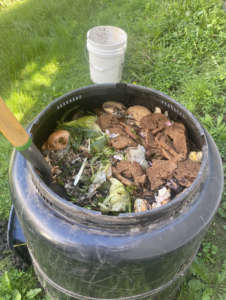
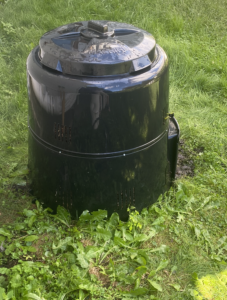
In just a couple of months, I’ve been turning about 20 pounds a week of household organic material into compost—all in my little Earth Machine composter that they provided for me. At that rate, my backyard will process more than 1,000 pounds, or roughly half a ton, of organic material in a year.
Think about that. Half a ton of material getting a second life right here at home—not hauled away, buried or burned, but turned into healthy soil that helps create beautiful gardens.
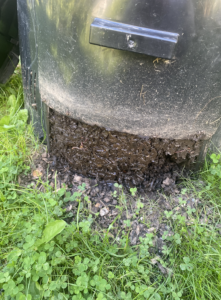
And I’m not just breaking down vegetable scraps and other organics, but meat and oils, too—something I never thought would be possible in my little home composting system. No maggots. No flies. Just red wigglers. My compost has become such a rich, healthy ecosystem that the jumping worms can’t tolerate it.
And my backyard isn’t unusual. Roughly two-thirds of Ulster County’s housing units are single-family, detached homes—that’s tens of thousands of households with outdoor space. If more of those households composted even 20 pounds of food waste a week, as I do, we could keep thousands of tons of organic material out of the waste stream every year.
I remove at least 20lbs of organics from my kitchen every week.
In Kingston, the backyard composter doesn’t have to stand alone. The City’s community composting programgives residents a way to keep the practice going year-round—when backyard composters freeze in the winter, residents can bring their food waste to the community system instead.
That’s the power of thinking about organic waste differently. We don’t need one giant solution—we need a network of local solutions working together: backyards, community composting programs and transfer stations. And Greenway has figured out how to make one of the smallest pieces of that system—the backyard composter—remarkably efficient.
That’s what makes Greenway’s invention so exciting. They’ve taken the natural process of decomposition and figured out how to make it work quickly and cleanly in an urban backyard—even with meat and oils. What once seemed like “waste” can become a resource right where it is generated. And that’s something I want everyone who reads KingstonCitizens.org to know: you can do this, too.
###
Who are you, and how long have you been doing this work?
Shabazz Jackson: Greenway Environmental Services is a regional organics recovery and soil company. We collect and process food scraps, leaves, brush, logs, pallets, and other organic materials and transform them into compost, mulch, topsoil, and specialty soil blends rather than sending them to the landfill. Our philosophy is to recover the organic fraction of the waste stream and return that fertility to the soil, while helping protect groundwater and surface water. We also design zero-waste systems and work with colleges, municipalities, businesses, and other institutions to develop and manage food-waste programs. We’ve been doing this work for more than 50 years. I’m an inventor, but what we invent are natural systems. The challenge is to take a process that nature designed to happen slowly and redesign it so that it works efficiently in an urban environment. We’re essentially learning from nature and figuring out how to make those systems work at the scale and speed that our communities need.
How do you do that?
SJ: In nature, organic material breaks down slowly and feeds small organisms that depend on it. That’s a good system for a forest, but in a city or neighborhood, we don’t want food waste sitting around, attracting maggots and flies and creating odors. We work with nature, not against it—to take the biological process nature designed and adapt it to the way we live. And we’ve succeeded at doing that.
What exactly have you invented?
SJ: The key is to engage during the decomposition process. We’re imitating the human digestion system. It’s a form of biomimicry. We give it the right biology and the right environment to decompose efficiently from the start.
We start with a rapid decomposition medium that goes into the Earth Machine, like the one you have, along with the food waste. We make it by mixing actively decomposing food-waste compost with wood chips from the local tree-service industry. When a tree is removed, the tree service grinds it into chips, and we use some of those locally sourced chips in our medium.
The medium introduces an active biological process right from the beginning. Instead of letting food waste sit around and begin to rot, we’re creating the conditions for it to break down quickly and aerobically. That’s the key.
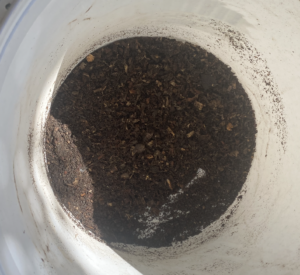
The “medium” at the bottom of my composter is now what I use to place on top of my weekly collection. It’s rich with red wigglers.
The second component is our odor-control blend, which is what you call the “lasagna.” Every time you add food waste to your kitchen container, you simply sprinkle a handful of the blend over it. It’s a biological filter that absorbs the sulfur generated when food rots. The odor control blend is a mix of completely cured and finely screened food waste compost and wood shavings which is effective in controlling moisture. At present, we are field testing the materials in preparation for household distribution. It’s available in bulk at our community composters in New Paltz and Poughkeepsie. We make the blend at our facility using clean wood shavings collected from a modern wood shop. The shavings are a clean byproduct of that process. We mix the kiln-dried wood shavings with fully decomposed and cured food-waste compost that has been finely screened. The blend inoculates the food with the bacteria needed right at the beginning of the process. That’s what makes it work.
So the goal at the start is to stop food from rotting?
SJ: Yes. The goal is to help it decompose in the right way from the start when it matters.
Why is the beginning of the process so important?
SJ: Because that’s where you establish the biological environment. We’ve inherited a culture that treats food as garbage as soon as we’re finished with it. Think about what happens in a typical household. Once a week, you take out a load of rotting food. Maybe you’ve separated it from the rest of your garbage and put it in a container provided by the municipality. But you’re still carrying over the culture of disposal. And the problem is that rotting food is inherently difficult to manage that way. It’s wet. It attracts flies and maggots. It smells. We’re trying to make a cultural transition—a cultural upgrade. At the base of that transition is the idea that we should stop having rotting food sitting around our kitchens. Instead, we need to separate this material and give it the biological conditions it needs from the very beginning.
Greenway’s “Odor Control Blend” is the magic sauce! I get 2-3 buckets a month that keeps me in the clear.
And some of the materials you’re using are themselves made from waste?
SJ: Yes. That’s one of the reasons we can keep the cost so low. We’ve figured out how to take commercial waste and turn it into a resource.
How do you work with local businesses while keeping their food waste as close to its source as possible?
SJ: We want to encourage food waste to go to the closest appropriate local facility. For example, we have a contract with Adams Fairacre Farms, and we also work with the Culinary Institute of America. Both generate food waste locally. Adams has a store in Kingston, and the CIA is in Hyde Park, close to UCRRA. So, in keeping with our principle of managing waste as close to its source as possible, it doesn’t make sense to haul that material all the way to New Paltz when UCRRA is right there. We send their food waste to UCRRA.
So you don’t believe that everything needs to go to one centralized facility?
SJ: No. There is no one-size-fits-all solution for removing organics from the waste stream. We need to start thinking differently. We’re looking at each waste stream and asking what makes the most sense locally.
How does compost connect to food systems?
SJ: In nature, soil and food are part of the same cycle. Plants take nutrients from the soil, and organic material eventually returns those nutrients to the soil. If we’re designing a sustainable food system, we should be doing the same thing. The composter and the garden shouldn’t be separate—they should be part of one system. You might bring in materials at the beginning to establish a garden. That’s a one-time contribution of material we’ve recovered from commercial sources. After that, the food waste generated in the surrounding community can be broken down and returned to the soil, helping maintain the fertility of the garden. The food feeds the soil, and the soil helps grow more food. That’s how nature works.
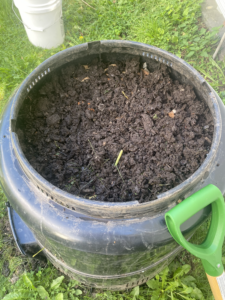
After breaking up my food scraps, I add about a 1/2 inch of medium from the bottom of my composter
Haven’t we already built a decentralized waste system?
SJ: In many ways, we have. Ulster County’s goal is to recover 90 percent of the waste stream by 2050. And the county has already invested in a decentralized system to help get there. UCRRA is the hub, and the 19 transfer stations are the spokes. That’s a significant investment in infrastructure that is already spread throughout the county. So I don’t think the question is whether we should have a decentralized system. We’ve already made that choice. Now we need to develop it. The question is: How do we use the system we’ve already built to recover 90 percent of our waste? That means looking at what each transfer station can do, how we can remove organics from the waste stream, and how we can connect the different pieces.
What does this have to do with the future of Ulster County’s waste system?
SJ: Everything. I think we need to stop pursuing projects like Global NRG and decide what kind of system we actually want to build. There is only one pool of money. UCRRA already has access to roughly $60 million in bonding—enough to invest significantly in a more decentralized system. I’m currently serving on the UCRRA Zero Waste Committee, and I think our first job should be to decide is if we want a centralized system, or do we want to develop the decentralized system we already have?
Why is removing organics from the waste stream so important?
SJ: Because you can’t get to zero waste without removing organics from the waste stream. Food waste is one of the largest parts of what we’re throwing away, and it doesn’t belong in a landfill or an incinerator. It belongs back in the biological cycle. There isn’t one solution that will work everywhere. We need to look at what we’re generating, where we’re generating it, and what infrastructure we already have. And we have to pay attention to our largest industries.
Tourism is a major part of Ulster County’s economy, and tourism generates a tremendous amount of food waste. We can’t seriously talk about zero waste without figuring out how to keep that material out of the disposal stream.
New Paltz gives us an opportunity to demonstrate what this could look like. The Village has a significant tourism economy and a concentration of restaurants and other food-related businesses generating commercial food waste. The Town already has infrastructure at its transfer station. Why not put those pieces together and make New Paltz a model?
The transfer station could take the food waste generated by the Village’s tourism economy, and we could measure what happens when we actually capture that material—how much is diverted, how clean the stream is, what it costs, and how much compost and soil we can produce from it. That would give us a real-world demonstration that could be replicated in other communities across Ulster County.
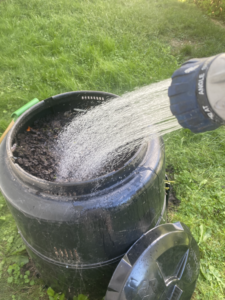
I always water my compost after adding to it, so that it’s damp (not wet). Moisture is required to break organic material down efficiently.
What do you think Greenway’s role is in this transition?
SJ: Greenway has the solution. Our society has the problem. We’ve been preparing for the day when people finally say, “Okay, Shabazz. We’ve heard enough.” When that day comes, we’re ready. In fact, we’re ready now.
Our role was to invent natural systems and figure out how to make them work in the places where people live. Nature has already designed a system for breaking down organic material. Flies, mealworms, bacteria and other organisms do that work naturally. But when we live in an urban environment, we need to manage that same material differently. Our challenge is to create the conditions for it to break down without the flies and the odor.
And that’s where people come in. Maybe you have a small piece of property. Maybe you’ve invested thousands of dollars and countless hours into your backyard garden. You’re already investing in the food you’re growing. Why not take the organic material you’re already generating and turn it back into the soil that makes your garden more productive?
That’s what Greenway is here to do: take what nature designed, adapt it to our urban environment, and use it to meet people’s needs. We don’t need to start from scratch. We need to connect the pieces we already have—and build a system that keeps organic material close to where it is generated, puts it back into the soil, and move Ulster County toward its goal of recovering 90 percent of its waste by 2050.
If you’re interested in Greenway’s backyard composting program and other services, contact Shabazz and Josephine at: gr*********@*ol.com
This is the latest in our ongoing series following efforts to close the Leachate Loophole.
By Rebecca Martin
We’ve written about Kingston’s role in New York’s landfill leachate problem, and the issue has received significant press attention. But people are still learning about what is happening here—and there is an important reason to pay attention right now.
Leachate is “garbage water”—the contaminated liquid created when rain moves through buried waste and is collected at the bottom of a landfill. It can contain PFAS, heavy metals, pesticides, industrial chemicals, and other pollutants.
In early 2025, the City of Kingston notified the Town of Hurley that it would no longer accept its landfill leachate from the Hurley landfill, a NYS Superfund site*. Following state-required testing, however, Kingston ultimately continued accepting it.
The City was working from a single sample tested for only three contaminants, providing a very limited picture of what may be present in landfill leachate. The state subsequently told the City that the results were below the applicable thresholds for the three contaminants tested and therefore met current standards. It is difficult to understand how “meeting current standards” can be considered an adequate threshold when sewage treatment plants are not monitoring for or designed to remove the full range of toxic chemicals that are present in leachate. Dilution is not the solution to this pollution.
The Proposed Rules Exempt Inactive Landfills—Including Those Sending Leachate to Kingston
There is another serious problem for Kingston. Every landfill currently sending leachate to the City of Kingston’s sewage treatment plant is inactive. Yet the proposed regulations, as currently written, exempt inactive landfills from the new treatment requirements. That means that if the regulations are adopted as written, every landfill currently sending leachate to Kingston could remain exempt from the new source-treatment requirements—allowing this flow of pollution to continue for another generation.
A landfill does not stop producing contaminated leachate simply because it stops accepting garbage. The chemicals and other pollutants remain in the buried waste, and leachate can continue to be generated for decades.
If New York is going to establish new requirements for landfill leachate, those requirements need to apply to active, inactive, and closed landfills.
Now is the time for action.
The state’s proposed regulations present a once-in-a-generation opportunity to require treatment at the source—before landfill leachate leaves a landfill.
As far as we are aware, we have not yet seen public engagement in this rulemaking from Kingston’s elected or appointed officials, Ulster County legislators representing affected communities, or the County Executive’s Office. If they have submitted comments, taken a position, or otherwise engaged, we would welcome being informed so we can share that information with the community.
There is still time, and participating is easy. The public and officials can submit comments, call for the regulations to apply to inactive landfills, support stronger source-treatment requirements, and ask the state for a transition plan for municipalities like Kingston that currently receive landfill leachate.
Ulster County Resource Recovery Agency Executive Director Marc Rider has signed onto the statewide coalition letter supporting stronger regulations. We appreciate his participation. We hope Kingston and Ulster County officials will use this opportunity as well.
The public comment deadline is September 9. This is an important opportunity for our local leaders to make their positions known—and help ensure that the state’s new regulations actually address the problem.
* Correction: The Town of Hurley landfill is a state Superfund site, not a federal Superfund site.
If you represent an organization: Sign on to New York River Watch’s public comment letter by September 8 and join the 75+ organizations that have already signed on.
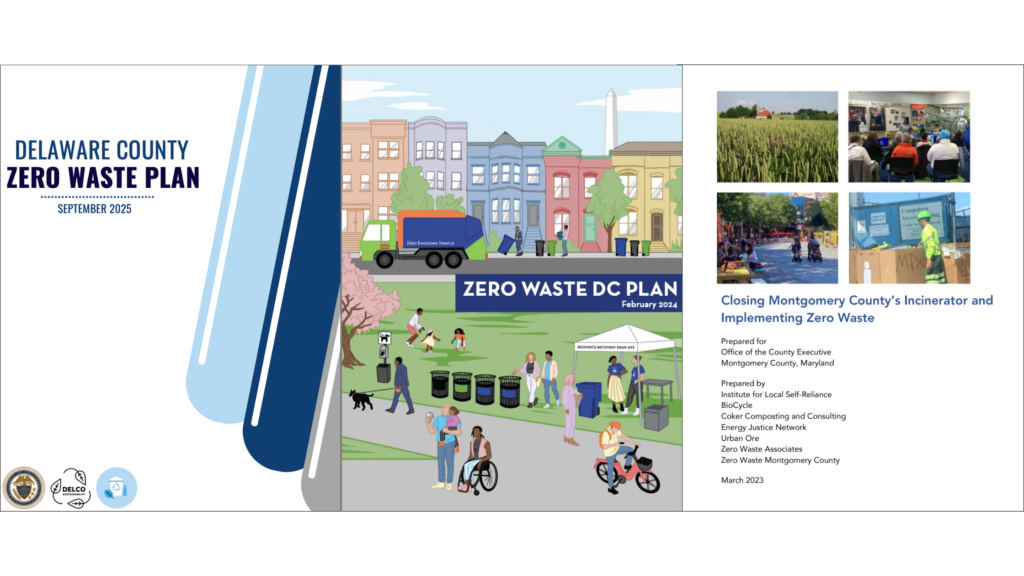
This is the latest in our ongoing series following efforts to move Ulster Toward Zero Waste. The images above are examples of Zero Waste Implementation Plans, and can all be found for review at: https://energyjustice.net/zerowaste/
By Rebecca Martin
There is an important and encouraging development in Ulster County’s zero waste planning: community members now have a seat at the table—at least for a couple of months.
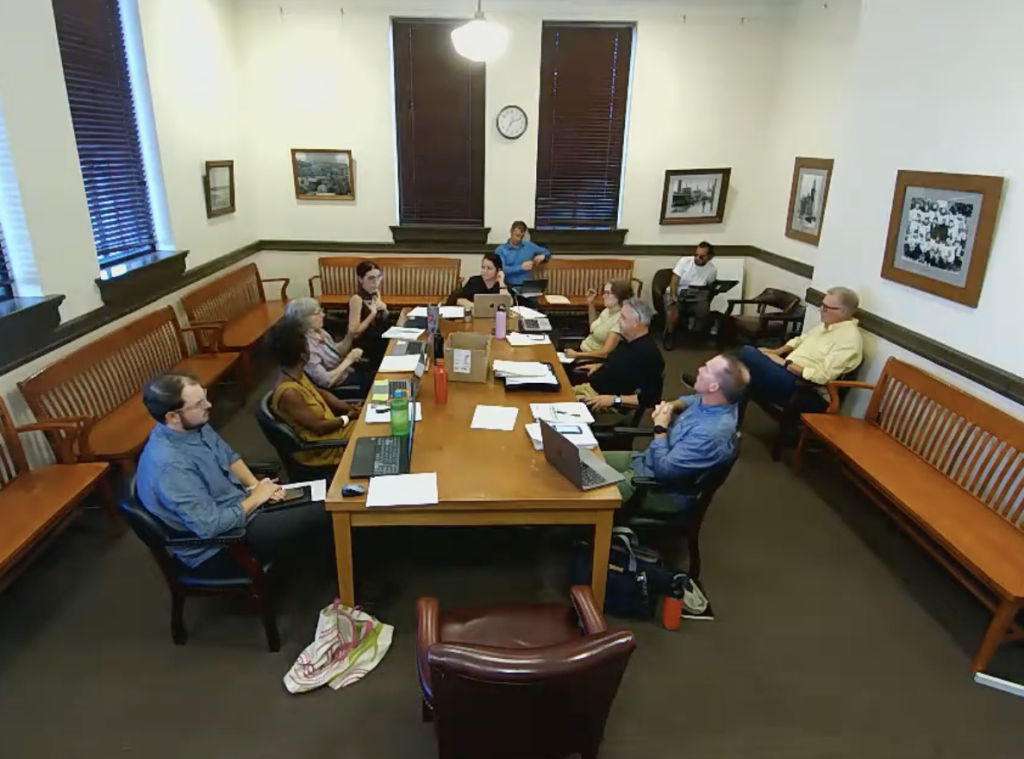
The Ulster County Resource Recovery Agency (UCRRA) Zero Waste Committee selected four community members to help develop a Preliminary Zero Waste Implementation Plan (ZWIP): Shabazz Jackson, Manna Jo Greene, Claudia Joseph, and me, representing KingstonCitizens.org.
Chaired by Chris Hurlbert, the committee recently opened non-voting seats to community members interested in contributing to the planning process. It is a positive step toward bringing community voices into recommendations for a more credible, practical, and sustainable zero waste future.
Because our participation is limited, we have a lot to learn and accomplish in a short period of time. We need to understand what UCRRA is doing, where it is headed, and how our work can best support recommendations to its Board.
Its Local Solid Waste Management Plan (LSWMP) is updated every ten years and addresses how the county manages its solid waste system—including collection, transfer, recycling, disposal, and infrastructure. The next plan is expected to be adopted in time for 2030, which is why we are working now to help incorporate zero waste initiatives into it. But adding zero waste initiatives to an LSWMP is not a substitute for actually planning how we will reduce waste. The initiatives need a plan behind them.
A ZWIP, which Ulster County urgently needs, serves a different purpose. It provides the roadmap for reducing the amount of waste we generate and send into the system in the first place. That means establishing measurable reduction and diversion targets, identifying the policies and programs needed to reach them, assigning responsibility, identifying investments, and creating a way to measure and adjust progress.
The zero waste committee heard that UCRRA may already be at or beyond its 30% reduction goal ahead of 2030. However, the “current data is unreliable” to establish exactly where the county stands.
That is exactly the kind of work that a ZWIP should analyze to establish a reliable baseline, examine the data we already have, identify what is missing and create a transparent way to track what is being reduced, diverted, and ultimately sent to disposal.
Why a Real ZWIP is a Worthy Investment
Hiring an experienced consultant for a ZWIP could be one of the smartest investments the county makes. Ulster County has already invested millions in its transfer station system. A ZWIP can help maximize that investment by identifying how those facilities can do more to prevent, separate, reuse, compost, and recycle materials before they become waste for disposal.
A good consultant could help identify which strategies will have the greatest impact, and establish what our communities, businesses, institutions, UCRRA, and county government each need to do to make them work.
An investment of approximately $80,000–$100,000 could provide that foundation. The key will be creating a strong RFP based on Zero Waste Hierarchy and selecting a consultant with a demonstrated track record in zero waste implementation—not simply waste management.
That is smart leveraging of the investment that has already made. Before committing to a major new infrastructure, we should first understand what we can achieve through waste prevention, reuse, source separation, composting, recycling, and other strategies—and what infrastructure is actually needed after those opportunities are maximized.
If UCRRA Sees Global NRG as a Pathway to Zero Waste, It Belongs in the Zero Waste Committee Conversation
The question becomes particularly important now, because UCRRA is considering a proposed $125 million + Global NRG project. Global NRG is the proposed large-scale mixed-waste processing facility that would take municipal solid waste and use mechanical and other technologies to recover materials and divert from disposal.
After a decade or more of zero waste work in Ulster County, we should have a ZWIP that documents what has been accomplished, what remains to be done, and how the county will get from its current position to 30/60/90. We do not have that plan yet, and we need one
During the meeting, Rider described Global NRG as “…one of the main projects to get us to Zero Waste.” If that’s the case, it belongs in the Zero Waste Committee’s conversation. That is a significant claim for a project carrying a $125 million + price tag and potentially requiring imported waste to keep it operating. We all want to avoid sending waste to Seneca Meadows, and some believe that we may ultimately need to consider a landfill in our own county—but we don’t know that yet.
The committee is not being asked to approve or reject Global NRG; its role is to develop recommendations for the UCRRA Board. To do that responsibly, members need to understand how this proposed infrastructure fits with source reduction, reuse, source separation, composting, recycling, and other strategies—and whether it is actually necessary to achieve 30/60/90.
Connecting the Pieces
Right now, several pieces are moving forward: the Zero Waste Committee is developing zero waste “initiatives” for consideration in UCRRA’s LSWMP, while the Ulster County Legislature is developing zero waste policy guidance.
These efforts should reinforce one another. UCRRA brings operational expertise; the Legislature can advance policy; the Zero Waste Committee can develop practical initiatives; community representatives can bring public experience and accountability; and a qualified zero-waste consultant can help identify gaps, evaluate alternatives, and bring these pieces together into a measurable implementation plan.
But the county needs to do the planning before it locks itself into the “put or pay” infrastructure for 20-25 years.
Get Involved and Take Action
The next UCRRA Zero Waste Committee meeting is Thursday, September 10 at 5:00 PM at UCRRA, 999 Flatbush Road in Kingston, with a livestream available on UCRRA’s YouTube channel, @ucrra5008. The committee meets publicly, and there is an opportunity for public comment at every meeting. The next meetings are October 15, November 12, and December 3. Meeting materials are posted by UCRRA before each meeting.
Attend these meetings. Ask questions. Use public comment.
Fund a ZWIP. Support a 2027 budget amendment of $80,000–$100,000 to hire a qualified zero-waste consultant to establish a baseline, identify realistic ways to reduce and divert waste, evaluate alternatives, and determine what infrastructure is actually needed.
Pause Global NRG. Ask the Legislature to support pausing the $125 million + project until this work is completed. While UCRRA is responsible for the project, its financial and long-term impacts will be felt by Ulster County communities and taxpayers. You can also reach out to your local municipal government officials to ask them to advocate for the same.
Let’s do the planning first—and make the major infrastructure decisions after we know what our communities can actually achieve.
That need has become clearer given what we are now seeing in the neighboring Town of Ulster, where now three very large BESS projects are being proposed in close proximity to Kingston. Imagine being a small town board suddenly having to manage three major environmental review processes under an outdated zoning code that doesn’t account for large-scale battery storage. That means making consequential decisions while still trying to understand the technology, the risks, and what the community needs. Kingston has an opportunity to avoid that predicament by taking the time to establish the right framework before a project arrives.
The City’s Zoning Working Group, following the recommendation of the Climate Smart Kingston Committee, has advised the Common Council to amend Kingston’s zoning code to address BESS. Notably, a member of the Working Group questioned whether the Common Council itself has the expertise needed to craft a BESS ordinance. That concern should not be dismissed. Getting this right will require the City to first identify the critical questions that must be answered, engage the appropriate independent experts, and develop a thoughtful, well-informed path forward. That takes time.
Why does this matter?
Battery storage is an important part of the clean-energy transition. The question isn’t whether Kingston should support energy storage. The question is how—and where—we should allow battery facilities to be built.
Lithium-ion battery storage presents safety considerations that are different from many other types of development. Batteries can experience thermal runaway, which can produce intense fires, release flammable gases, and, under certain conditions, create explosion or deflagration hazards. Fire-safety standards for BESS address fire propagation, separation distances, ventilation, testing, and emergency response—and those standards continue to evolve.
That matters when we’re talking about facilities in or near densely populated areas. Kingston needs to understand what those standards mean for our geography: setbacks from homes and businesses, emergency access, water resources, firefighting capacity, emergency-response plans, and the potential cumulative impacts of multiple facilities in the region.
A Familiar Problem: When Developers Define the Zoning
The zoning code did not clearly define what that term meant or distinguish conventional utility infrastructure from a privately developed power plant. That ambiguity became a major point of contention and ultimately prompted the Town to revisit its zoning—but only after the community narrowly avoided a serious mistake, thanks to the sustained and determined work of local advocates who fought to stop the polluting project.
A Moratorium Is About Time—and Public Process
If a BESS project is submitted before Kingston amends its zoning, the developer will be judged under the zoning in effect when the application is filed. Kingston could then find itself debating how to regulate a complex project after it arrives, rather than establishing the rules in advance.
A temporary moratorium of at least six months would give the Common Council time to understand Kingston’s particular assets and vulnerabilities, consult qualified experts, and establish a thoughtful regulatory framework that could be ready in the new year.
We tried to move that conversation forward and shareda draft proposal, along with concerns behind it, with several Council members, including Sara Pasti, Michele Hirsch, and Marissa Marvelli.
But the proposal never entered the public process. Our request was not placed on a committee agenda, so the public never had the opportunity to explain the proposal, answer questions, or hear Council members publicly consider and debate it.
That is where gatekeeping becomes a problem. The public owns this civic space, and committees should provide a meaningful place for residents to bring forward ideas and engage their elected representatives. If an issue cannot reach a committee, where is the public supposed to have that conversation? Three minutes of public comment at a Council meeting is not a substitute for meaningful public deliberation.
Council members may ultimately decide that a moratorium is not the right approach. That is democracy. But the public should at least have the opportunity to make the case.
When One Door Closes…
Although the Council process did not provide a path forward, we looked for another avenue. Because the Conservation Advisory Council (CAC) advises the Common Council, we brought the conversation there. In advance of the CAC’s recent meeting, we spent hours speaking with members about why Kingston should thoughtfully consider how its zoning accommodates BESS before an application arrives.
Questions were also raised about the rationale for a moratorium, including comparisons with the Kingston Climate Smart Committee’s position. But different advisory bodies have different roles and areas of expertise. The Climate Smart Committee’s work on clean-energy policy does not necessarily address the specific zoning, land-use, infrastructure, and public-safety questions Kingston must consider when developing rules for BESS. Those questions deserve to be evaluated on their merits and with the appropriate expertise.
The CAC was also told by its administrator, Julie Noble, that the Executive Administration would veto any BESS moratorium. While she may have insight into the administration’s position, a potential veto should not substitute for the Council’s own consideration of the issue or the public’s opportunity to make its case. Before deciding whether a moratorium is appropriate, Kingston should have the opportunity to fully consider the questions, hear from residents, and understand what it needs to know.
A Moratorium Gives Kingston Time to Do the Work
A temporary moratorium is a legitimate planning tool—one that a handful of municipalities right here in Ulster County have used to give themselves time to understand BESS and establish local rules.
But they miss the point of a temporary moratorium. A moratorium doesn’t replace the work of a task force—it gives the City time to do that work without a BESS project arriving while the rules are still being sorted out.
A project could be submitted tomorrow, next week, or while the task force is getting organized. A temporary moratorium would give Kingston the time to establish the task force, bring in qualified experts, review its zoning, and develop protective standards without interruption.
That’s good planning.
Take Action
Call your Kingston Common Council member. Ask them to pause BESS applications by supporting a temporary moratorium of at least six months so the City can review its zoning, bring in qualified experts, and develop thoughtful, protective regulations before a project arrives.
By Rebecca Martin A new statewide report from New York River Watch exposes a regulatory loophole that allows toxic leachate from landfills to enter New York’s rivers and lakes.
During the report’s five-year study period, more than half a billion gallons of landfill leachate—highly contaminated “garbage water” created when rain and snowmelt move through buried waste—were sent to municipal sewage treatment plants each year from 2019 through 2023. While the report documents five years of data, this practice has been going on for decades. The report, The Leachate Loophole in New York State, found that approximately 167 million gallons were ultimately discharged into rivers and lakes designated as drinking-water sources—about one-third of the statewide total.
The Hudson River was among the four waterbodies receiving the largest volumes, along with the Mohawk River, Lake Ontario, and Niagara River.
The City of Kingston Is Part of the Statewide Problem
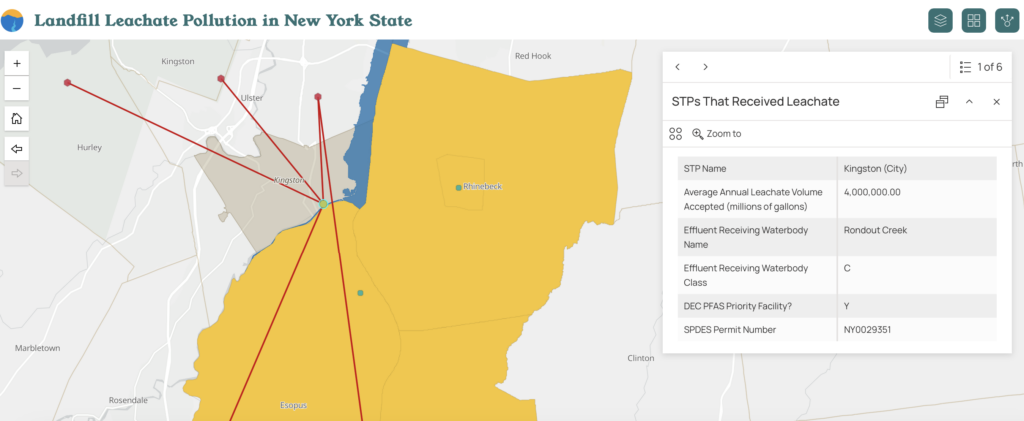
This statewide report reveals that the problem is happening right here in Kingston, where garbage water is being sent to our municipal sewage treatment plant, discharged into Rondout Creek, and carried directly into the Hudson River.
Landfill leachate can contain PFAS, heavy metals, pesticides, and other industrial pollutants. Yet instead of being treated at the landfill, it is often trucked or piped to municipal sewage treatment plants designed primarily for domestic sewage.
The scale of the problem goes far beyond any single contaminant. EPA lists 86,000 unique chemicals that are used in manufacturing or processing in the U.S., not including chemicals used in foods, drugs, and cosmetics, with more added everyday. Many of these chemicals ultimately become part of the products we use, the waste we throw away, and potentially the leachate produced when that waste is buried. We cannot know what we are not looking for. That makes focusing on any one contaminant an unrealistic way to address treatment of garbage water. However, if PFAS is the “poster child” chemical of concern today, here is a sobering truth: chemical companies can create and introduce synthetic chemicals faster than we can understand them, regulate them, or protect ourselves from their consequences—because in the United States, the burden of proof falls on the public to demonstrate harm after exposure, rather than on manufacturers to prove safety before these chemicals enter our products, communities, and environment. The number of known PFAS chemicals has grown from approximately 14,000 to more than 21,000.
Twenty-one thousand.
And that number will continue to grow because manufacturers can continue introducing new chemicals without first having to demonstrate that they are safe. Even more concerning, some PFAS treatment methods can create new PFAS compounds that we don’t even know exist. We are trying to manage a problem involving more than 21,000 known PFAS chemicals, while New York’s enforceable drinking-water standards currently address just two: PFOA and PFOS.
Two.
That is one reason we should not be sending landfill leachate containing potentially thousands of synthetic chemicals into sewage treatment plants and relying on those facilities to protect our rivers and lakes that serve as drinking-water supplies to more than 2-million people statewide.
In the case of the Hudson River, according to the report, 73.4 million gallons of leachate entered the Hudson between 2019 and 2023, including approximately 5 million gallons discharged near Hudson 7 drinking-water intakes. Nearly 4 million gallons of that passed through the City of Kingston Sewage Treatment Plant, which accepts leachate from the Town of Hurley, Jockey Hill, the Town of Ulster, and the Town of New Paltz.
“The findings in this report raise significant concerns for the more than 107,000 residents who rely on the Hudson River as their primary source of drinking water,” said Rhinebeck Mayor Gary Bassett, Chair of the Hudson River Drinking Water Intermunicipal Council (Hudson 7). “Protecting drinking water requires a proactive approach that prevents pollution from reaching the river in the first place, rather than relying solely on treatment after it enters the drinking water supply.”
We cannot wait years to address a problem we know is happening today. Kingston should stop accepting raw, toxic garbage water at its sewage treatment plant now.
But Kingston cannot solve this problem alone. Our state representatives and the New York State Department of Environmental Conservation—whose permitting framework has allowed these loopholes and gaps to persist—must step in immediately to help Kingston and affected landfills find a safe short-term solution.
### Read the Report and View the Interactive Map www.leachateloophole.org Take Action https://leachateloophole.org/take-action/ New York has a once-in-a-generation opportunity to get this right. DEC must bring together the best scientific, engineering, and public health expertise to create a plan that truly protects our water, communities, and environment. The state must not create a system that shifts the costs and consequences of toxic pollution onto communities, and the landfills that profit from managing this waste must be held accountable. Public comment is open through September 9. Attend Public Webinars to learn about the report and answer questions https://leachateloophole.org/webinars/ Join us for public webinars on Thursday, August 13 at noon and 6pm, to learn about the report’s findings, the implications for New York’s drinking water and environment, and what can be done to close the leachate loophole in New York State.
WHAT
The Kingston Common Council is considering a proactive, temporary outdoor burn ban in Kingston during times of high fire danger, as determined by the NYS Department of Environmental Conservation (NYSDEC). The proposed temporary burn ban would prohibit: “All outdoor burning, including bonfires, campfires, warming fires, outdoor fireplaces, chimneys and cooking fires in city limits until further notice.”
By working together during periods of elevated fire risk, Kingston can reduce preventable sources of ignition and help protect our community before an emergency occurs.
WHEN
Public Hearing: August 26 at 6:00 PM
WHERE
Kingston City Hall
420 Broadway
Kingston, NY
HOW TO PARTICIPATE
Attend the public hearing and sign up to speak.
You can also email the Kingston Common Council (please indicate your Ward/alderperson) to share your support for a proactive, temporary burn ban when DEC designates Kingston at “high fire danger” by writing to: co***********@*********ny.gov and em*****@*********ny.gov
Last November, Ulster County experienced the largest and most numerous wildfires in recent history. In response, surrounding communities took action and put temporary outdoor burn bans in place.
The reality is that the conditions around us are changing. The Kingston Common Council is considering a proactive approach that would allow our community to reduce risk during the most dangerous conditions: a temporary outdoor burn ban during periods of high fire danger as determined by the NYS Department of Environmental Conservation (DEC). This is an opportunity for our community to work together to reduce preventable risks and protect our neighborhoods, residents, first responders, and the environment we all share.
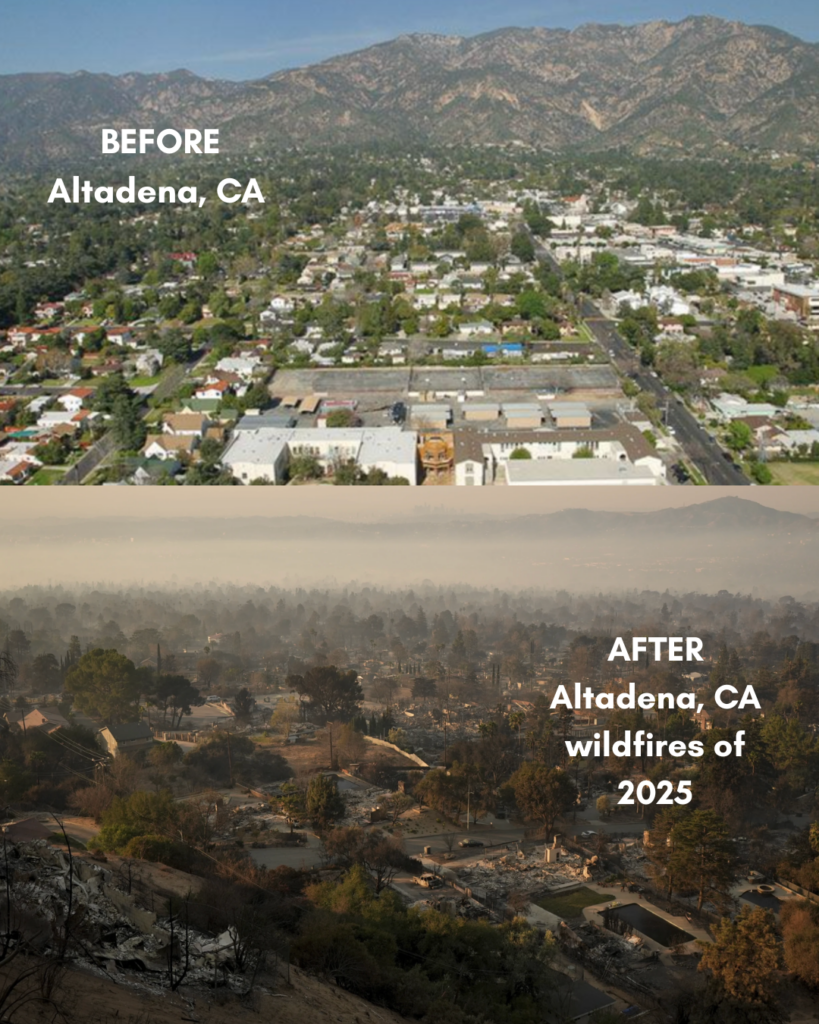
Worsening climate change has increased fire danger risks here in Kingston. Our city has unique characteristics that create additional concerns, similar to the conditions that existed in Altadena, California before the devastating 2025 Los Angeles wildfires. Kingston is a densely populated city with predominantly wood-framed homes, located in a valley that can trap air and wildfire smoke. New research is changing how we understand urban wildfire risk: in urban wildfires, houses become the fuel. Our urban fire departments are prepared for more frequent, smaller-scale fire events, but they are not traditionally equipped to respond to the comparatively rare but potentially devastating large-scale events that climate change is making more likely.
The proposed temporary burn ban would reduce preventable sources of ignition during the periods when fire conditions are most dangerous. It would prohibit: “All outdoor burning, including bonfires, campfires, warming fires, outdoor fireplaces, chimneys and cooking fires in city limits until further notice.”
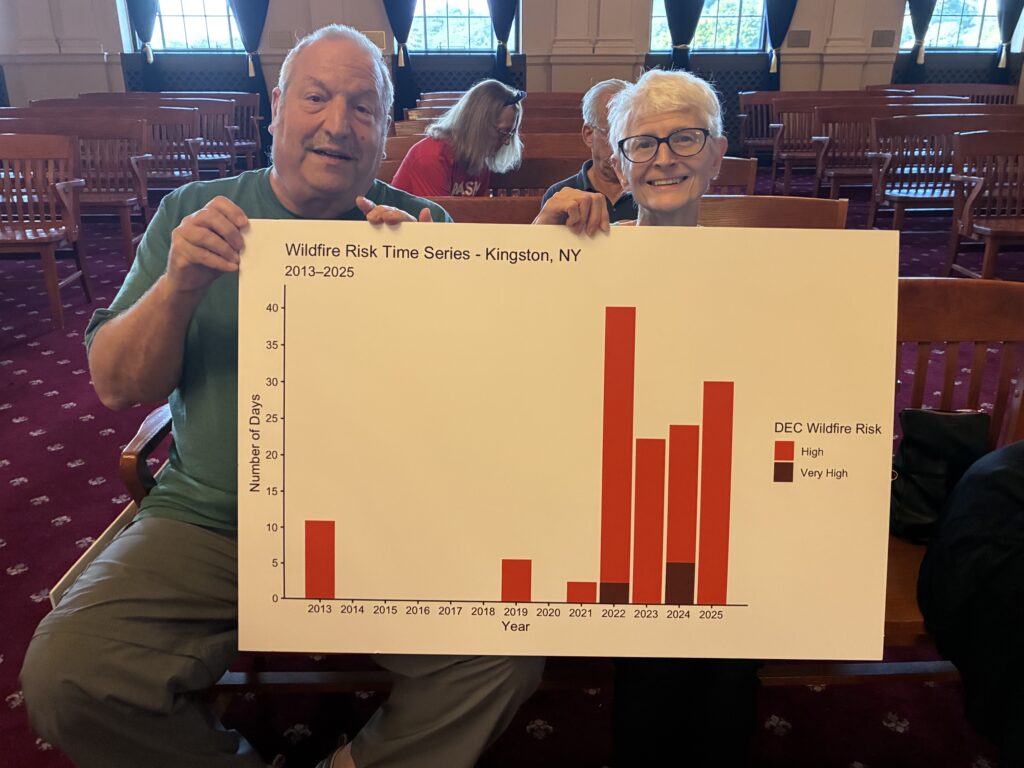
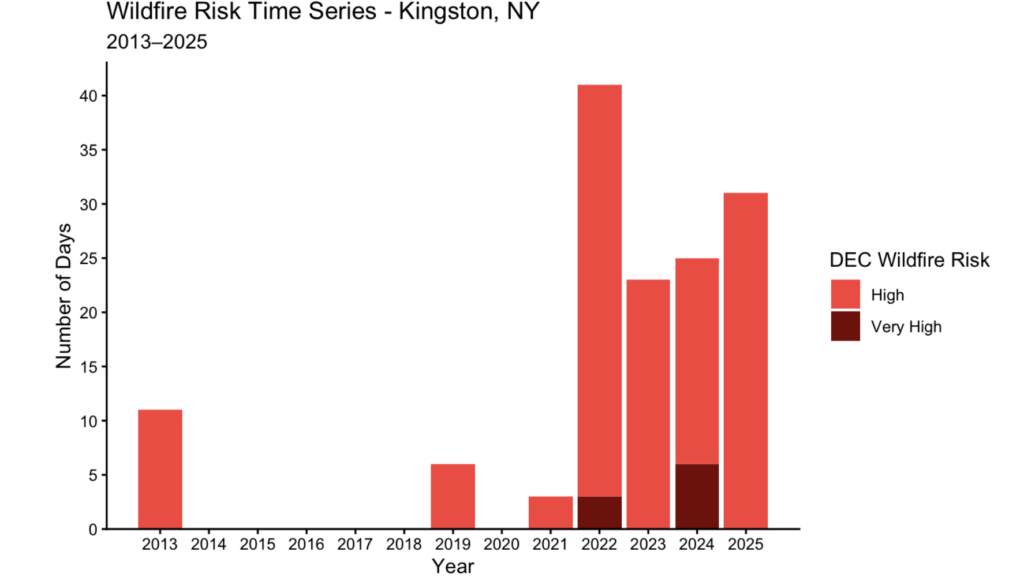
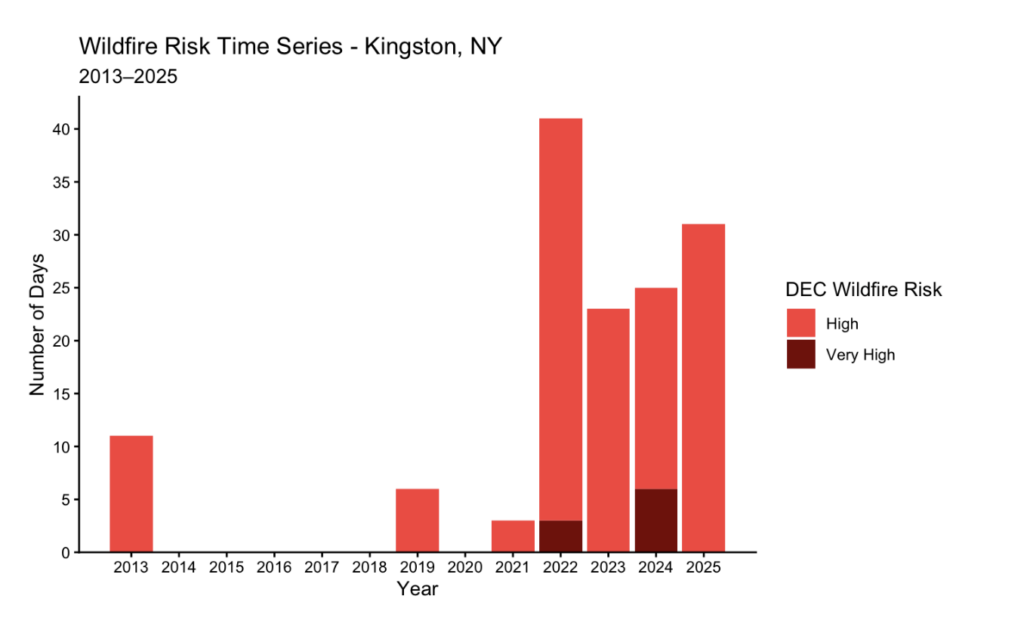
The proposal would take effect when the DEC designates Kingston as being at “high fire danger” risk — conditions where fine fuels ignite easily and fires spread rapidly, often becoming difficult to control. According to data compiled from the DEC Fire Danger Map, Kingston’s number of “high fire danger” days has increased from 0–1 days in 2013 to 38 days in 2022 and 31 days in 2025, reflecting the growing need for proactive action.
This conversation is not new. The Common Council first considered a burn ban in summer 2025, and the Administrative Code already prohibits brush fires and the creation of dense smoke within city limits year-round (§135-3 Prohibition of emission of dense smoke; exceptions). This proposal builds on those existing protections by addressing additional sources of ignition during periods of high fire danger.
The Kingston Common Council is seeking public input at a public hearing on August 26 at 6:00 PM at Kingston City Hall. Please attend, sign up to speak, and make your voice heard.
If you are planning to speak at the public hearing or submit a comment, consider sharing why you support a proactive, temporary outdoor burn ban during periods of high fire danger. You might talk about what the increasing risk of wildfire means for Kingston, why prevention matters, and why communities should take action before an emergency happens. Your comments do not need to be long. Personal experiences, local knowledge, and your reasons for supporting proactive action are valuable.
This is the second installment in a series documenting my efforts to better understand—and ultimately address—the growing problem of freight train horn noise in the City of Kingston, NY. Each post follows the next step in the investigation. Read the first one here
My first post about the freight train noise situation in Kingston was published on KingstonCitizens.org on June 4th. The next day, I heard back from the state DOT. Brian Galvin assured me that they were making regular observations of CSX trains and that the company was operating within the law. There was nothing to be done from a state regulatory standpoint. I mentioned that I had been making 12- and 24-hour-long recordings of the trains so that I could have concrete examples of clock times, patterns, and length of blasts to bring to CSX. When I pressed him further about whether their records of the train horn patterns made these recordings redundant, and whether the observer(s) had taken decibel readings, he replied that they had made no recordings, no notes, and had taken no decibel readings.
This was surprising, especially about not taking decibel readings—how would the DOT know whether CSX was within the regulations, since a decibel range was one component of them? It firmed up my resolve to get a professional decibel meter that’s activated by sounds above the threshold of your choosing, that logs the readings, and connects to a phone app. I’ll position this on a light pole that’s about a dozen feet from the tracks.
I also heard from Esmerelda, who lives near the Gage St. crossing. She vented her frustration in one long, continuous, sleep-deprived paragraph, then thanked me for listening. She included screenshots of boilerplate responses from the Surface Transportation Board as evidence of feeling herself in a helpless position.
Two days after posting (June 6), as I turned onto Flatbush Ave. to start my walk to work, I saw that a train was stopped in the crossing, with lines of cars waiting in both directions. It was about 8:30 AM. I walked west on Flatbush, away from the crossing, and turned south on Foxhall. I could see the train blocking the Foxhall crossing, a third of a mile down the street. As I walked towards it, the train eventually moved on, but the crossing gates stayed down. As dozens of cars and some pedestrians waited, probably now late for work, the minutes ticked on. Reaching the gate, I could have easily walked around it and continued my direct route to work. But I must maintain unimpeachable behavior where this issue is concerned! So I turned right on Cornell, looking back after a block. The gates were still down, and a truck swerved around them to cross the tracks. It was 8:47 and, returning to the crossing, I called the CSX hotline number on the gate’s sign, reporting the issue to some guy in Florida. Then I continued down Cornell to work. As I crossed Smith Ave., I saw a car at that crossing, also empty, swerving around the gates. I turned to look back at Foxhall one last time, clearly visible a half mile away, before heading south on Broadway, at 8:57 AM. The gates had finally lifted, after about 25 minutes.
At work, in the course of chit-chatting with my colleague as she watched our museum gift shop, I mentioned my efforts in opposing the train noise. A couple overheard as they browsed and introduced themselves, each with a tale of suffering the same noise, she at her place near the Gage St. crossing, and he at his house in
Lake Katrine. As he told me, bitterly laughing, about growing up in Brooklyn near the elevated subway to Coney Island and being rattled by the constant closing-door chimes, audible even to him ten blocks away, it slowly dawned on me where his current house was located: on that street. His street runs parallel to the tracks, not a hundred feet from them, between Esopus Creek and Rte. 9W, one that I had imagined to be the absolute worst place in the greater Kingston area if you were train noise-sensitive, a fabled corridor of house-shaking vibration and nerve-shattering horn blasts. He had lived there for ten years and finally gotten semi-used to it.
“How long has it taken to get used to it?” I asked.
“Ten years,” he replied.
The next day (June 7), as I drove home westbound on Flatbush, rounding and descending the curve at the corner of the cemetery, lo and behold, there was a train as it crawled through the crossing. I reached the queue, stopped, turned off my car, and stared at the train, which appeared to be moving about 10 MPH. After 5-10 minutes, at 10:43 AM I took a brief video on my phone to show how slow it moved. The train then slowed even further, finally stopping. At 10:45, joining several other cars, I made a U-turn, zigzagging through back streets to get to Highland Ave., then Prince, on to Broadway, checking to see if any crossing was clear on the way to shorten the detour. Every crossing from Flatbush to Smith Ave. was blocked by the train. I got home at 10:55 and watched until the train left, at 10:57. It was another instance, for the second day in a row, of a train jamming up Midtown for about 25 minutes.
On June 17, KingstonCitizens.org hosted a webinar presentation by Jess Conard of the rail safety advocacy group Rail Watch (railwatch.net.) Never imagining that she would become such an advocate, she had indeed, following the 2023 toxic rail accident in her town of East Palestine, Ohio, which released tons of chemicals (some whose names you wouldn’t even recognize) into the water supply. You can find a link to the recording of the webinar here: “Rail Safety Starts at Home: Lessons from Our Conversation with Rail Watch’s Jess Conard” (KingstonCitizens.org)
She shared a number of eye-opening things with us:
Municipalities can do nothing about blocked crossings;
The FRA (Federal Rail Administration) is staffed by good people, but has structural problems that make it not great at enforcement;
Before being outlawed, freight lines routinely used “DOT-111” tanker cars that ended up being prone to punctures, even at 15 MPH;
CSX trains routinely carry pressurized gasses, volatile fuels, corrosive substances, spent fuel, industrial manufacturing agents, the liquid byproducts of plastics recycling, benzene, and chlorine, the latter confirming my suspicion that a derailment resulting in breached tankers could create something like a WWI battlefield in the middle of Kingston;
My idea of setting up a camera to record a train’s cars and then looking up what each tank carried had already been done, by a friend of someone at Riverkeeper;
And that, as revealed by Suzanne Cahill, present in the webinar, Kingston has no publicly available disaster preparedness plan for a derailment.
Jess also educated us about Precision Scheduled Railroading, a cost-saving technique that has been adopted by major freight carriers, and which Jess states is not in the public interest. PSR results in trains that are often one to two miles long, which increases the chance of derailments. The distance from Smith Ave. crossing to Flatbush Ave. crossing is about 3⁄4 of a mile (measured on the track line), so the likelihood of a train stoppage resulting in more than one blocked crossing is obviously much higher. She had looked up how many blocked crossings had been reported by the public through the FRA’s Blocked Crossing Reporter webpage, for the entire county of Ulster in a one year period: it had been 3.
Here are the ones I have personally observed since those outlined at the start of this post, a total of 6 in June and 5 in July, all at only 6 of the crossings that exist in Ulster County:
June ND – Foxhall and Flatbush crossings blocked on a Sat. or Sun. afternoon for about 20 minutes (At this point I had no idea how frequently I’d be reporting these, thus no date noted.)
June 25th, 8:10 AM, Kingston crossings from Flatbush to Smith Ave. blocked – over 15 min. – reported to FRA – reported to CSX online
June 28th, 6:10-6:24 PM, Foxhall, stopped for 8 min. of that period – reported to FRA and CSX
June 30th, 2 PM, Foxhall, gates down 1 minute but no train – reported to FRA and CSX
July 1st, ca. 12:10 PM, Foxhall, train stopped for at least 10 min.
July 2nd, 4:51 PM, Flatbush crossing closed at least 25 min, train stopped for at least 15 min. – reported to FRA and CSX
July 24th, 11:55 AM: Flatbush crossing blocked by a stopped train for an unknown amount of time – reported to FRA and CSX
July 25th, ca. 9:18 AM, stopped train blocking Flatbush, 10th from the last car in crossing, not blocking Foxhall, left crossing at 10:18 AM – reported to FRA and CSX
“Reported to FRA and CSX online” means that I visited these sites and reported the details of these incidents here:
Flatbush Ave. Kingston NY – crossing ID 507088E
Foxhall Ave., Kingston NY – crossing ID 507091M
Smith Ave., Kingston NY – crossing ID 507093B
NOTE: you must report within 7 days of the incident.
After the webinar, I looked up a train accident Jess had mentioned, which took place on July 6, 2013 in Lac-Mégantic, Quebec. According to the Wikipedia page, which you should look at, “a freight train carrying Bakken Formation crude oil rolled down a 1.2% grade and derailed in downtown Lac-Mégantic, resulting in the explosion and fire of multiple tank cars. Forty-seven people were killed. More than 30 buildings in Lac-Mégantic’s town centre (roughly half of the downtown area) were destroyed, and all but three of the thirty-nine remaining buildings had to be demolished due to petroleum contamination. Initial newspaper reports described a 1 km (0.6-mile) blast radius.”
Were this to have happened at the Smith Ave. crossing, most of Midtown Kingston would be leveled, and most of the city uninhabitable. Lac-Mégantic has one quarter the population of Kingston. The disaster resulted in a number of changes to laws and railroad procedures, though it would not be until 2023 that “federal transport minister Pablo Rodriguez announced the commencement of preliminary work on a bypass.” If this accident hadn’t been enough to push Canadian authorities to re-reroute the train line outside of towns, I couldn’t imagine it happening in Kingston.
All the other avenues for change that I’d looked into, on the city, county, state, and federal level, had begun to look like dead ends. Add the fading of initially enthusiastic contacts who had reached out to me in support, and I began to wonder what it would take to reach my initial, humble goal, of simply quieting down the train honking at night. It started to seem like all or nothing—either the trains would have to be compelled to make massive structural changes to accommodate the needs of Kingston’s inhabitants, or they would be allowed to maintain a status quo of not changing a single tiny thing—with the balance leaning heavily towards nothing.
While writing this piece on July 25th, my partner, who had just left to drive to work, texted me that our crossing, and all the other five crossings up to and including Smith Ave., were blocked for the second time that morning. I grabbed a lawn chair, a sun hat, and my laptop and sat by the tracks writing this, glancing at the stopped, weatherbeaten, graffiti-ed train cars as they sat in silence, squirrels climbing on them, and even a bunny rabbit hopping around it. It moved on ten minutes later and I made my reports:
July 25th, 11:05 AM, all crossings from Flatbush to Smith Ave., train stopped until 11:26, left crossing at 11:30 AM. – made three reports (Flatbush, Foxhall, and Smith) to FRA and CSX online.
These two incidents woke me out of my weekslong resigned attitude. It now seemed that all this wasn’t in my head, just me being an overly sensitive light sleeper, but instead there was something egregious happening. The fact that Kingston drivers now pull a u-turn almost instantly when they see a stopped train doesn’t mean that we have to be resigned to the behavior of a corporation that does nothing for our city except make noise and cause inconvenience, to say nothing of the possibility that it could, at any minute, cause a catastrophic disaster.
In the coming week, I’ll be reaching out to Jess Conard and state representatives Michelle Hinchey and Sarahana Shrestha to continue pressing this issue. Otherwise, all I can do for the moment is report stoppages, which is what I encourage you to do using the links above. Write these incidents down on your phone or in a notebook, too. The lesson from Jess Conard is that activism can work, and her webinar provides lots of examples of this. But in order to resist CSX, we must first assemble a body of evidence, one long horn blast and one stopped train at a time.
Battery Energy Storage Systems (BESS) are becoming an increasingly important part of New York’s clean energy transition. As these facilities are proposed throughout the state, communities are being asked to make decisions involving complex issues related to zoning, land use, public safety, emergency response, environmental impacts, and long-term planning.
Kingston has not yet received a BESS proposal. That gives us an opportunity to prepare before a project arrives.
This is not a ban on battery storage. It is a planning tool that gives Kingston time to understand this emerging technology, engage the public, seek appropriate expertise, and develop regulations that are thoughtful, legally sound, and protective of the community.
It also allows the City to develop a strategy for engaging with BESS projects outside Kingston’s boundaries. While home rule limits the City’s ability to regulate neighboring municipalities, Kingston can establish how it will participate when regional projects may affect our community members, emergency response systems, infrastructure, or the environment.
At the recommendation of Climate Smart Kingston, the City’s Zoning Working Group is asking the Common Council to review local laws and determine what changes may be needed to address BESS. Kingston’s current regulations were not written with utility-scale battery storage in mind. Updating them requires careful consideration.
Many municipalities are consulting fire safety specialists, engineers, planners, environmental professionals, and attorneys with BESS experience. We should do the same. Outside expertise can help ensure Kingston’s policies are technically informed and protective of our community.
The State’s model language and guidance are useful starting points, but they are not a substitute for local planning. Kingston has unique neighborhoods, infrastructure, environmental resources, and public safety considerations that deserve careful evaluation, and the Kingston Common Council should take the time that is needed to create an approach that supports clean energy goals while ensuring projects are designed to protect the community.
Without a pause, a developer could submit a proposal before Kingston has completed its review or updated its laws. Once a project enters the approval process and SEQR begins, the City’s ability to use a moratorium or establish new standards specifically to address that pending project is no longer available.
The result could be years of conflict over a specific proposal before Kingston has first decided what standards should guide these decisions. Instead of creating a thoughtful framework in advance, the City could find itself responding to a project under existing rules that were never designed for this technology.
Communities like the Town of Ulster are already navigating three different BESS proposals and the complex questions that come with them. Kingston has an opportunity to learn from those experiences and prepare before facing the same challenges.
Take Action
With the Zoning Working Group’s incoming recommendation to review Kingston’s zoning code and local laws for BESS projects, the Common Council should consider a 6–12 month moratorium as a reasonable and responsible step while the City develops a thoughtful strategy. This time would allow the Council to engage the public, determine what expertise is needed, seek outside professional assistance where appropriate, review zoning, safety, and emergency response considerations, develop protective standards, and establish a process for regional engagement.
The goal is not to stop battery storage – it is to ensure that if projects move forward, they do so with careful planning, strong protections, and community confidence.
The City of Kingston has officially begun the process of reviewing and reforming its City Charter, and this is one of the most important opportunities residents will have to shape how our local government functions for decades to come.
Sign up for the Civic Lottery for the opportunity to serve on the Charter Review Commission. Kingston’s charter, first established in 1896 and last updated in 1994, serves as the city’s constitution. It establishes the framework of our local government, including how leaders are selected, how laws are adopted, and how residents participate in civic life. This revision is a rare opportunity to help determine how Kingston will be governed well into the future.
Whether or not you’re interested in serving on the commission, you can still participate by completing the community survey and sharing your thoughts about Kingston’s government. Every voice matters.
Visit Engage Kingston to learn more about the City Charter, the revision timeline, and the many ways you can participate.
Catch Up on the Charter Reform Process
For those who want to better understand how we got here, we’ve also created a Charter Reform Memo that brings together everything we’re aware of since we first began advocating for charter reform. It provides the history, key milestones, public discussions, reports, and other background information to help residents quickly come up to speed and participate in the process with a solid understanding of what’s come before.
Understanding the Different Forms of Government
One of the Charter Review Commission’s responsibilities will be to evaluate the different forms of municipal government available to Kingston. In addition to our current mayor-council system, the commission will consider alternatives such as a City Administrator or City Manager form of government.
To help inform that conversation, back in 2014 we hosted a public forum featuring the City Administrator from the City of Beacon and the City Manager from the City of New Rochelle. They explained how these forms of government operate, the responsibilities of each position, and how they work with elected officials to manage city operations.
It was an enlightening discussion then, and it is even more relevant today as Kingston begins this important review. If you haven’t watched it, now is an excellent time to do so as our community explores the options for the future of Kingston’s government. That educational forum is as relevant today as it was then.
Public education is one of the most important public institutions we have. It shapes not only individual student outcomes, but the long-term health, equity, and stability of entire communities.
Yet, when it comes to decisions about budgets, programming, staffing, and priorities, community engagement is often reduced to a single moment: the annual budget vote and limited public comment.
If those details had been clearly disclosed at the time of the vote, would the budget have passed as presented? Or would it have been rejected, triggering a second vote and forcing a broader conversation about priorities, including whether administrative costs and structural spending should be reviewed before student programs are reduced.
Transparency and Engagement Must Happen Before Decisions Are Made
If we take seriously the idea that public education belongs to the community, then engagement of the real impacts of a budget must begin earlier when priorities are being set.
This requires structured participation, specifically, a Community Advisory Board embedded directly into the budget, planning and engagement process? Such a body should not be symbolic. It should be representative, with members selected by lottery from each school in the district to avoid gatekeeping and provide broad participation. Terms could be staggered and two-year in length to preserve continuity and independence. The board could meet regularly and have a defined, substantive role in shaping district priorities before decisions are made.
The people most affected by education policy are often the last to be meaningfully consulted. Families navigating academic supports, enrichment opportunities, and transportation needs are frequently presented with decisions only after they are already in motion.
At that point, public comment alone cannot meaningfully shape outcomes. Communities should not be placed in a position where they must respond to decisions after the fact, when meaningful alternatives are no longer on the table.
Families Informed of Major Schedule Changes at Bailey Middle School During Orientation
Parents report that at Bailey Middle School, the elimination of the homework period, activity period, and late buses—along with the extension of the school day to 3:00 p.m.—was recently announced during orientation for their incoming 5th graders.
These are not minor scheduling changes—they are structural decisions that directly affect how students learn, receive support, and participate in school life.
The homework period has provided essential academic support for English language learners and students with IEPs and 504 plans.
The activity period supports enrichment, student engagement and social development through clubs, the arts, and athletics – opportunities central to well-rounded middle school experience.
The removal of late buses creates immediate barriers for working families who rely on extended-day transportation for both academic support and participation.
Take action
We are learning about additional cuts and changes across the district with similar impacts. Bailey Middle School is a clear example—and apparently, not an isolated one.
Call on the Kingston City School District Board of Education to pause implementation of these unexpected changes at Bailey Middle School and instead, reopen a real, accessible process for parent and community input before moving forward.
There is a proposed measure that has been before the Kingston Common Council since May, 2025. It was introduced by members of the Hudson Valley Air Quality Coalition (HVAQ), where I serve as director.
HVAQ is concerned with threats to air quality in the Hudson Valley, including those posed by wildfires. Although wildfire smoke can have serious air-quality impacts, the proposal is focused on a different aspect of the issue: reducing wildfire risk and improving fire safety for the Kingston community, their homes and property.
A proposal will come before the Public Safety Committee this Wednesday, June 24 at 6:30 pm, when language may be suggested for a law.
A brief Background
Following the unprecedented wildfires in Ulster County in November of 2024, several members of HVAQ wrote a letter to Mayor Noble asking why he had not enacted a total, temporary burn ban on all outdoor burning, as almost all other jurisdictions in Ulster County did at the time. We received no response from the Mayor. We sent a follow-up letter and again received no response.
HVAQ brought the concern to the full Kingston Common Council in May, 2025, and has since been advocating at the council’s Laws and Rules Committee meetings (last fall) and Public Safety Committee meetings (this term)for the Council to enact a temporary ban on all outdoor burning whenever the New York State Department of Environmental Conservation (DEC) designates Kingston as being at “high fire danger” risk,according to its fire danger map.
The public can review our background history sheet that we presented to the council, as well as my responses to Public Safety Committee members’ concerns at the May meeting.
Kingston faces special risks as a densely populated city with predominantly wood-framed homes (much like the City of Altadena, CA, which tragically burned to the ground—and which also shares two other unnerving similarities with Kingston: it is located in a valley and has a paid, professional fire department).
There is currently no proactive temporary ban on all outdoor burning in place in Kingston in times of high fire danger. The only restriction is a ban on the burning of brush, which is in place year-round. During the Ulster County wildfires in 2024, the surrounding jurisdictions recognized that although the state had banned the burning of brush, other outdoor burning was left unaddressed, and they acted to ban all outdoor burning until further notice.
According to Professor Eli Dueker of Bard College during his presentation to the Laws and Rules Committee in September 2025, worsening climate conditions—dryness, more frequent high winds, lower relative humidity, and dry fuels—make fire danger more likely. A chart constructed using DEC archived data shows the number of “high fire” days from 2013–2025, demonstrating how fire danger has increased over this period. Worsening climate conditions (dryness, more frequent high winds, lower relative humidity, and dry fuels) make fire danger more likely.
Attached is a chart showing the number of “high fire” days from 2013–2025, per DEC information:
Community members of Kingston deserve to be protected by a proactive ban on all outdoor burning when we are designated as being in “high fire danger” status. This is a policy that a city as progressive and climate-aware as Kingston should not hesitate to pass.
If you are concerned for your homes, property, lives, and the environment, I urge you to contact your alderperson and the entire Common Council at co***********@*********ny.gov as soon as possible and advocate for the proposed measure below:
When the DEC designates Kingston as being at “high fire danger” risk, per its fire danger map, the city would put into effect a temporary burn ban prohibiting all outdoor burning, including bonfires, campfires, warming fires, outdoor fireplaces, chimneys, and cooking fires within city limits until further notice.
Please also consider attending the Public Safety Committee on Wednesday, June 24 at 6:30 pm in Conference Room 1 of Kingston City Hall. Public comments will not be entertained, but signs are encouraged.
Last evening, we had the opportunity to host Jess Conard of Rail Watch for an engaging and timely conversation about rail safety, emergency preparedness, and the role communities can play in protecting themselves from potential rail-related incidents.
A key takeaway from the discussion was the importance of prioritizing rail safety in local emergency planning. Conard emphasized that rail safety is a community issue and local emergency plans should account for the realities of freight rail traffic moving through our communities, including the possibility of derailments and hazardous material releases. “Communities are entitled to those plans, and they should be updated every 10 years. That’s required by law.” she said.
A Local Gap in Kingston’s Emergency Preparedness
As part of our discussion, participants reviewed the City of Kingston’s disaster preparedness webpage. While the site contains a large collection of emergency preparedness resources, it can be difficult to navigate, presenting community members with a lengthy list of links and materials that offer little organization or guidance. Of note, we could not identify any publicly available information outlining what community members should do in the event of a train derailment. With publicly available data indicating that between 20 and 30 trains pass through Kingston each day, the lack of derailment-specific guidance is a significant gap in the city’s public emergency preparedness resources that needs attention.
While railroads are regulated primarily at the federal level, there is still significant work that can be done locally, and those local efforts can have a ripple effect upward. Most impactful outcomes often starts at the community level.
Based on discussions last evening with participating city staff and community members, there does not appear to be a dedicated public forum or advisory structure focused on rail traffic and rail safety issues in the City of Kingston at this time. Establishing a mechanism for ongoing discussion would be a meaningful opportunity and a strong initiative. It could begin with a small group of Kingston community members coming together to develop a strategy to bring to the Common Council, the executive branch, and other key stewards to initiate next steps.
Rail Safety Legislation Moving in Albany
The conversation highlighted two important rail safety bills currently advancing in New York State.
Senator Michelle Hinchey’s bill, S5748, would prohibit freight trains operating in New York from exceeding 8,500 feet in length, while allowing limited waivers through the Department of Transportation. Supporters argue that excessively long trains create operational and safety concerns and can increase risks associated with derailments.
Senator James Skoufis’s bill, S5713, would require railroad corporations transporting hazardous materials to notify the New York State Division of Homeland Security and Emergency Services, the Department of Environmental Conservation, and the Department of Transportation before traveling through the state. The legislation is intended to improve emergency preparedness and ensure that responders have access to critical information about hazardous cargo moving through New York communities. The bill passed the State Senate in June 2025 and remains active in the legislative process.
Community members in their districts are encouraged to reach out to learn more about these efforts, what support is needed to help advance this legislation, and what additional actions can be taken to move it across the finish line.
Concerned community members can come together to form a group that begins asking important questions. Search for others who are already organizing around these issues in the state, reach out, and collaborate to build shared momentum.
Good questions to raise include: What plans exist for a train derailment in our community? How would community members be notified in an emergency? What hazardous materials are moving through our area? Where can the public find clear, accessible guidance before an incident occurs? And are local emergency plans being regularly reviewed and updated?
Improving rail safety starts with understanding the specific risks in our community, identifying gaps, and working together to address them. Last night’s discussion was an important step in that process, and we look forward to continuing the conversation with local leaders, emergency managers, and community members across the Hudson Valley.